
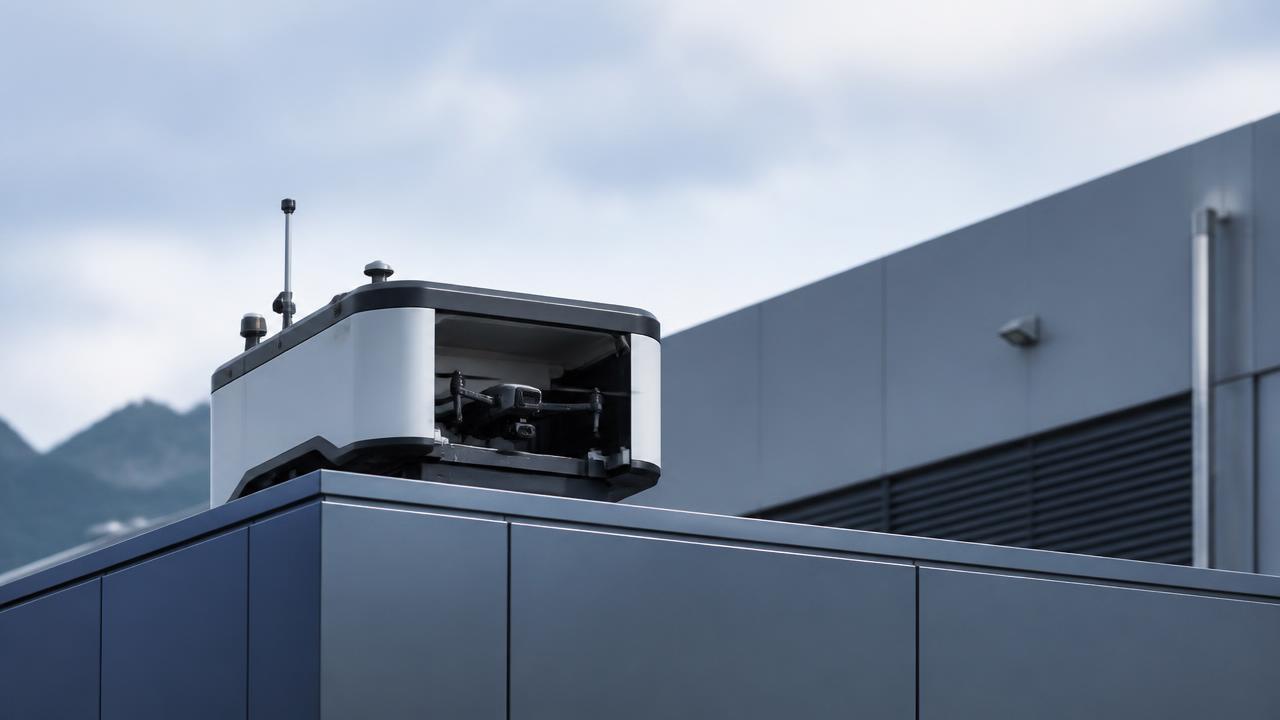
The drone is only one part of the service
For years, talking about drones in security meant talking about hardware: endurance, cameras, range or wind resistance. These are important variables, but on their own they do not solve an operational need. An organisation does not simply need a drone; it needs a capability that is available, safe, maintained and integrated into its procedures.
That is where the Drone as a Service (DaaS) model comes in. Instead of approaching the project as the isolated purchase of a piece of equipment, the client contracts an operational outcome. The service can bring together aircraft, dock, connectivity, maintenance, software, mission planning, regulatory management, support and integration with alarms, video or an alarm receiving centre.
The shift resembles what already happened with cloud computing. The conversation stops revolving around asset ownership and starts focusing on availability, service levels and the ability to integrate with the business.
An opportunity that is already gaining scale
The European drone ecosystem is no longer marginal. The European Commission estimates that the European drone services market could reach EUR 14.5 billion and create 145,000 jobs by 2030. The same strategy includes surveillance, within the applicable legal frameworks, among the services that could become part of European life during this decade. In addition, the European Union had invested almost EUR 980 million in 320 drone-related projects since 2003 when it presented its Strategy 2.0 in 2022 (European Commission).
Spain also shows growing adoption. AESA closed 2025 with 150,332 registered UAS operators, 30,620 more than a year earlier. The agency also recorded 262,885 training certificates issued (AESA). These figures do not equate to autonomous deployments or security services, but they do reflect an increasingly large operational and professional base.
What a genuine DaaS service must include
A complete service starts long before the flight. First the site is analysed: risks, sensitive areas, obstacles, coverage, emergency procedures and airspace constraints. Then it is defined which events can trigger a mission and who must validate it.
The operation must cover at least five layers:
- Infrastructure: aircraft, docking station, sensors and communications.
- Operation: routes, checklists, contingencies and responsible personnel.
- Compliance: operational category, training, documentation, insurance and permits.
- Integration: alarms, video, ARC, management platforms and incident history.
- Service: maintenance, updates, monitoring and availability metrics.
The model becomes especially relevant when there are several sites. Buying different equipment for each location creates technological islands. A shared service makes it possible to standardise criteria, learn from every mission and roll out new capabilities gradually.
Useful data is worth more than the flight
In security, flying is not the end goal. The goal is to reduce uncertainty. A perimeter alarm indicates that something has happened; a fixed camera only shows its field of view. A drone can add a mobile viewpoint and additional context, always within the authorised operation and the data protection framework.
That is why an indicator such as the number of flights says little on its own. It is more useful to measure service availability, the share of completed missions, the quality of the evidence, false activations avoided, the time until useful imagery is available and the traceability of every decision.
From visible product to invisible infrastructure
The best DaaS can become almost invisible to the end client. The security company keeps its brand, its commercial relationship and its procedures. Underneath, a specialised infrastructure coordinates the technology, the UAS operation and the necessary integrations.
This approach also enables a white label model: the partner extends its offering without having to build the entire aeronautical and technological capability from scratch. Technology stops competing with the existing relationship of trust and starts reinforcing it.
The question, therefore, is not "which drone do we buy?", but a far more useful one: what capability do we want to offer, under what conditions, and how will it fit into the security response? That is the difference between deploying a device and building a service.